How to Read Eyeglass Perscription From Frames
How to Read My Prescription
How to Read
My Prescription
When you leave your middle doctor'southward role and await at your prescription, it may seem like an unrecognizable series of numbers and abbreviations. It makes ordering prescription spectacles online challenging and overwhelming. Let's take a moment to decipher and understand what'southward on your prescription. Let's get started.
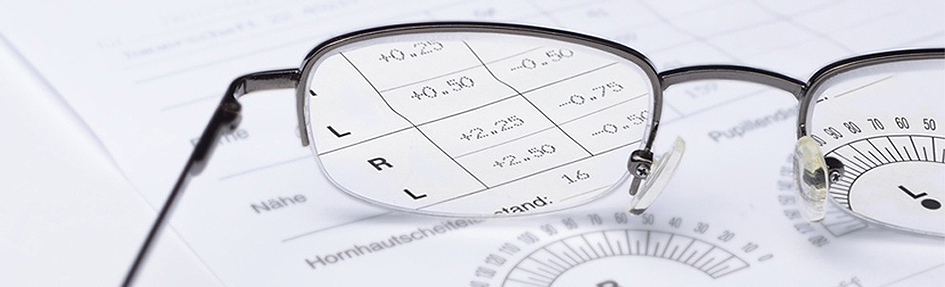
Have NV/DV/SV on your prescription?
NV stands for near vision for reading apply or figurer use.
DV stands for altitude vision for constant wear or daily use. Doctors unremarkably use this to distinguish different usage.
SV means single vision. Doctors use this to tell you that you need single vision lens instead of bifocal or progressive lens.
How To Read Eyeglasses Prescriptions?
And so you demand to know OD and Os. OD means 'right center' and OS ways 'left eye'.
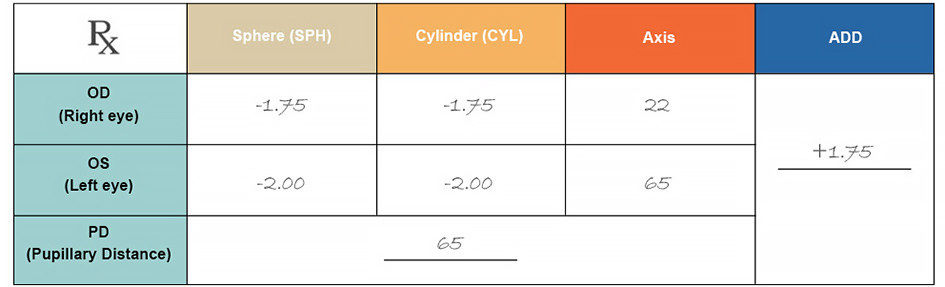
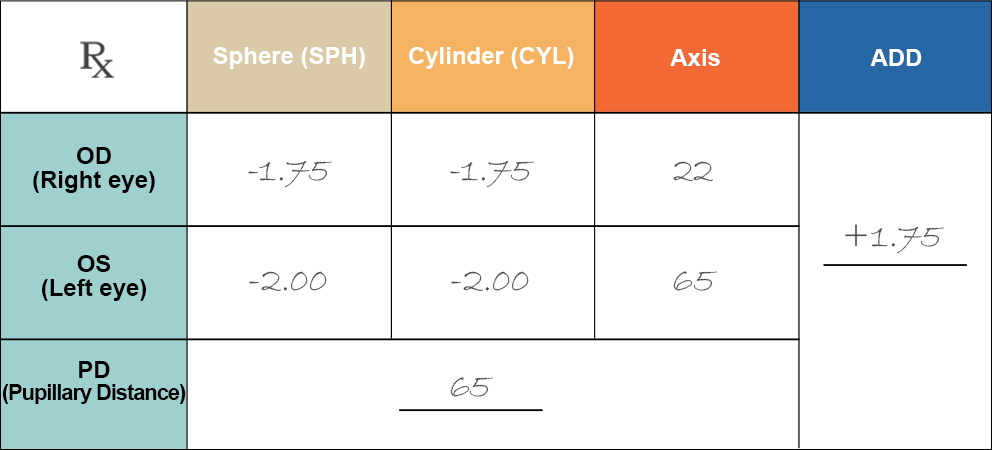
| SPH | SPH stands for sphere or spherical ability. This indicates the amount of lens strength. There will exist a plus sign for farsighted and negative sign for nearsighted - followed past a number. The larger the number, the stronger the prescription yous needed to correct your vision. |
| CYL and Centrality | If you have astigmatism, CYL and Axis volition be full in your prescription. Astigmatism is where the eye is not completely spherical but shaped more like a football. CYL or cylinder is the degree of how flat your eye is. The college the number, the more astigmatism you have. The AXIS represents the orientation or angle of your astigmatism. From ane to 180 degrees. |
| ADD | Add is an additional force for your lens for reading or upclose work. If you need reading, intermediate, bifocal or multifocal, or progressive lenses, this should be listed in your prescription. |
| PD | PD: This number indicates the distance from the center of one educatee to the middle of the other, and is an important number for lens customization. If your prescription doesn't have your PD on information technology, don't worry, nosotros have a tutorial that teaches you how to measure out your PD yourself. |
| Prism | Prism: This is the amount of prismatic power, measured in prism diopters ("p.d." or a superscript triangle when written freehand), prescribed to compensate for middle alignment problems. |
Other questions
Q: What is a PD?
PD stands for Pupillary Distance, which is the measurement from the center of one educatee to the center of the other. Your PD is an important factor and tells you where you lot look through the lens of your glasses and should be every bit accurate as possible. For people with stiff prescription, this is specially important. Yous tin normally find your PD on your prescription. Mostly speaking, the PD numbers for adults stays the same. The average PD range for adults is 57-72 mm and for kids is about 43-58 mm.
Q: I accept dual PD, how can I enter it?
A dual PD would be provided with 2 numbers and would appear and is the measurement of each pupil center to the center of the span of the olfactory organ, in millimeters. Dual PD appears in the following format: "31.5/31.5". When placing the order, please click "Ii PD numbers" to enter your dual PD.
Q: I have PLANO /PL under SPH on my prescription
If in that location is "Plano" or "PL" in the SPH section of an Rx, it ways no nearsighted or farsighted correction is needed. Just go out it as a zero or Plano when inbound the prescription on the club form on our website.
Q: I have SPHERE/SPH /S/DS under CYL on my prescription
If the optometrist wrote "DS" or "Sph" or "Spherical" in the Cylinder space, it indicates no correction and should exist entered as 0 on the order course. This ways that the eyeball is spherical and has no oblongedness, and consequently has no Cylinder or Axis values.
Q: I have Rest/BAL on my prescription
Rest indicates that the heart for which the designation is made, is not sighted, and that the same numbers should be entered in both optics, in order to have the lenses matched in advent and weight.
Q: I have PAL (progressive improver lens )on my prescription.
PAL,the Progressive Adjusted Lens. Because of the limited reading area of a progressive lens blueprint, the Add portion of a prescription is increased past a quarter of a diopter (typically) to recoup past increasing the size of the image. It does not change the size of that portion of the lens. If you have two Add values in your prescription (ADD +2.00 and ADD +two.25 PAL), the Add together value +two.00 should be used for both optics of bifocal while ADD value +2.25 should exist used for both optics of progressive.
Q: Can I use my contact lens prescription when ordering eyeglasses?
Unfortunately, contact lens and eyeglass prescriptions are dissimilar. The simple reason is because contact lenses sit directly on your eyes, while eyeglasses are held in front of your eyes. Though the prescriptions may announced similar, they will differ in strength and are not interchangeable. We cannot — and, for your safety, would not — use your contact lens prescription to make your glasses. And nosotros would suggest yous to contact your heart doctor to get your eyeglasses prescription.
I have a prescription, how to read information technology for different uses
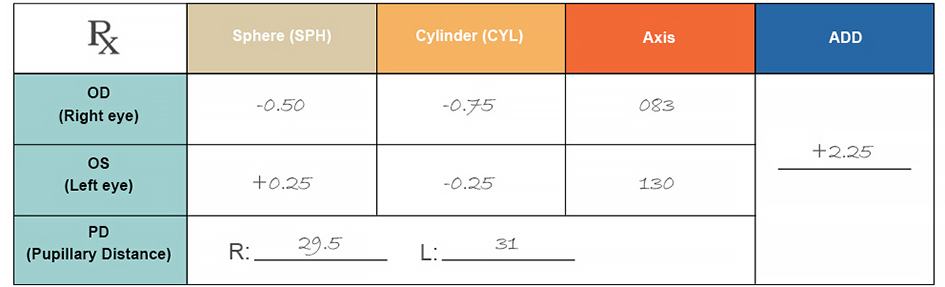
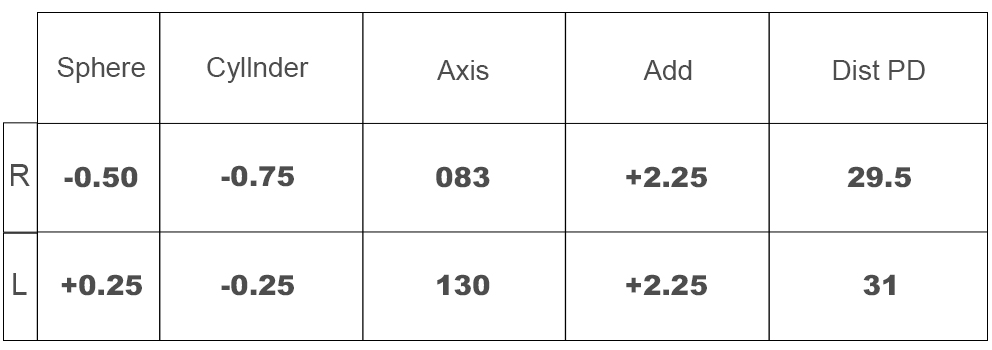
For progressive or bifocal spectacles, the prescription can exist read as:

For single vision altitude use, the prescription can be read as:

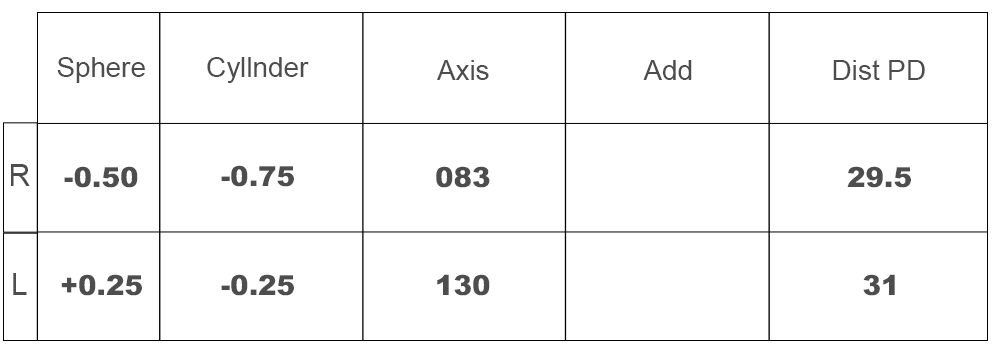
To convert a multi-focal prescription with Add together values for single vision distance apply, simply remove the Add values. The correction for the astigmatism will not change, and then the cylinder and axis will remain the same, regardless of the change in focal distance. Use the original distance PD listed in the prescription.
For single vision computer use, the prescription can exist read as:

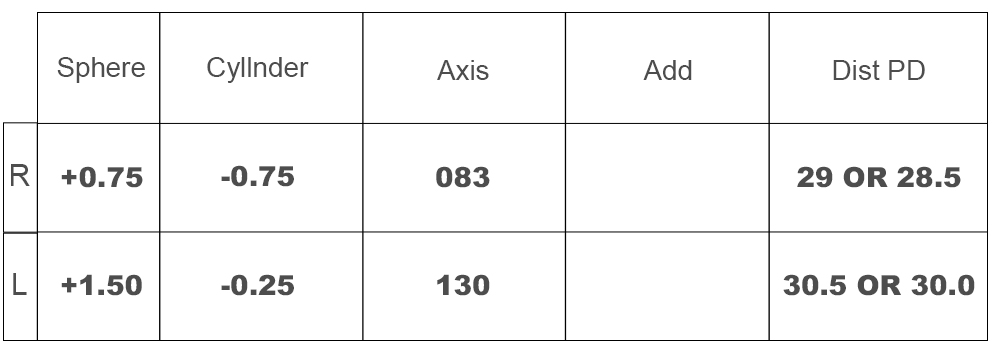
To convert a multi-focal prescription for single vision computer use, but combine one-half of the Add number and the Spherical number (If the Add cannot exist split evenly, such as ADD +two.25, both +1.25 and +1.00 tin can be used to convert the prescription). For example, if the Add together were +ii.25 and the OD-Sph was -0.50, the new OD-Sph for computer glasses would be +0.75; if the Sph were +0.25, the new Sph would exist +1.fifty. Consequently, the Add volition then become zero, the default. The correction for the astigmatism will not change, and so the cylinder and centrality will remain the same, regardless of the change in focal distance. Narrow the PD by ane-2 mm. If the PD of your basic prescription is 29.5/31.0, the PD for computer glasses would be 29.0/30.5 or 28.5/30.0
For unmarried vision reading utilise, the prescription can exist read as:

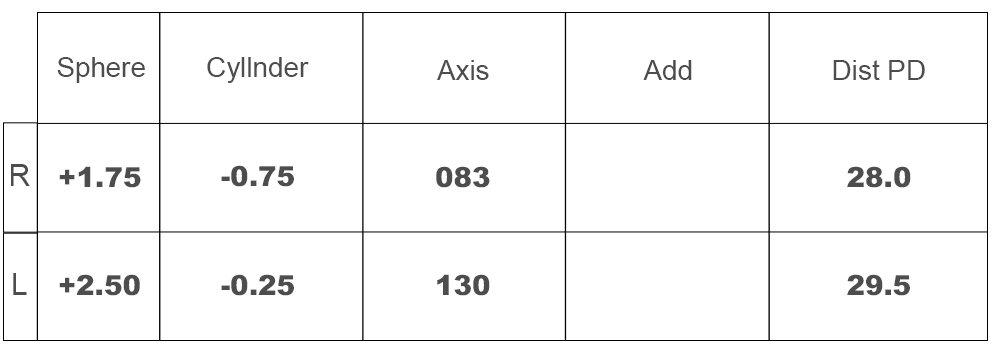
To convert a multi-focal prescription for single vision reading glasses, only combine the Add number and the Spherical number. For example, if the Add were +two.25 and the OD-Sph was -0.l, the new OD-Sph for reading glasses would exist +1.75; if the Sph were +0.25, the new Sph would be +ii.50. Consequently, the Add will then become nothing, the default. The correction for the astigmatism will not change, so the cylinder and axis will remain the same, regardless of the modify in focal distance. Narrow the PD by 3mm. If the PD of your basic prescription is 29.5/31.0, the reading PD would be 28.0/29.five.
That's it about prescriptions.
For more data, check our help eye. Nosotros hope this was informative and helpful!
Source: https://www.glassesshop.com/doc/how-do-i-read-my-prescription
0 Response to "How to Read Eyeglass Perscription From Frames"
Post a Comment